Mr. Bessey served three years in the 101st Ohio and was severely wounded at Stone River. The doctors were set on cutting off his leg, but Mr. Bessey resisted so strongly, declaring that if he was to die he would die with the leg on, that they gave way, and he pulled through with the leg that was afterwards of good service to him.Ionia Weekly Standard, 7 Feb 1913
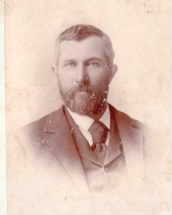
JACOB BESSEY was my great grandfather born in Ohio in 1840 to Jacob and Rosanna Bessey. Jacob was the middle of nine children, four brothers and four sisters. At age 22, he left home to fight in the Civil War.
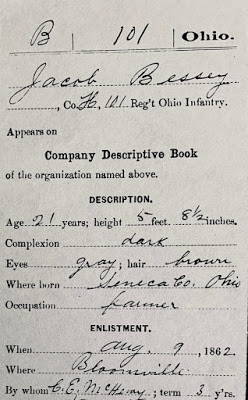
Jacob enlisted on 9 Aug 1862 in Bloomville, Seneca County, Ohio for a term of 3 years. He was listed as being 21 years of age, however he was actually 22 1/2. He was 5 feet 8 1/2 inches tall, had gray eyes, brown hair, and a dark complexion. His occupation was listed as farmer.
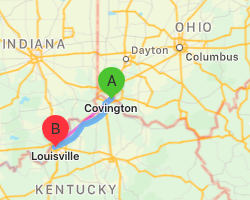
Jacob reported to Camp Monroeville in northern Ohio on August 30 ready for service. In less than a week the 101st Regiment left Ohio by rail and headed to Covington, Kentucky. By September 24 they were headed 100 miles south to Louisville.
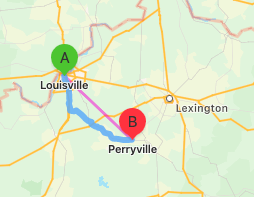
In early October they moved again, this time 75 miles southeast in pursuit of Gen. Bragg in Perryville. On October 8 they fought in the Battle of Perryville and the Union army was victorious. There were 22,000 engaged in battle for the Union. They lost 845 men that day, 2851 were wounded, and 515 were captured or missing.
By October 16, Jacob’s regiment was headed south to Nashville, Tennessee, where they would spend the next two months. Winter was setting in and many of the men were coming down sick with a fever. Years later William Myers wrote in an pension affidavit:
“Then said Jacob Bessey while in the line of duty at or near Rolling Fork, KY about the 25th Oct., 1862 having marched days in rain and snow encamped that night without tents or protection found themselves covered with snow the next morning. Many of the boys suffered from a severe cold, fever and sickness, the writer among them. Bessey was among them taken with severe rheumatism and was carried in the horse drawn ambulance to Camp Andy Johnston near Nashville. They arrived at the rest site the 26th Dec., 1862 where in five days they were to fight the battle of Stone River. Bessey insisted he would go with them…..”
Four months into his service, Jacob fought in the Battle of Stones River in Murfreesboro, Tennessee, one of the bloodiest battles of the Civil War. The battle lasted three days, 31 Dec 1962 to 2 Jan 1963. The Union Army lost almost 1,700 men in the battle. Another 7,500 were wounded. Over 3,600 were captured or missing.
Jacob took a musket to the right knee on the first day of the battle and the injury brought an end to his short lived front line duty. He would spend the next four months in the hospital for his injury, and probably recovering from being ill.
A tribute to Jacob in the Ionia Weekly Standard dated 7 Feb 1918 states the following about his war injury:
Mr. Bessey served three years in the 101st Ohio and was severely wounded at Stone River. The doctors were set on cutting off his leg, but Mr. Bessey resisted so strongly, declaring that if he was to die he would die with the leg on, that they gave way, and he pulled through with the leg that was afterwards of good service to him.
As of May 7 of 1863, Jacob is listed as “hospital detail nurse in Cincinnati, Ohio.” By September, he was no longer with the 101st but switched to the Invalid Corps which had been formed for disabled soldiers to serve in noncombat duties. For the next year, he is listed as a nurse. It is unclear what his duties were for the following year, although he may have continued as a nurse. He was mustered out in July of 1865. The injury to the knee would bother him greatly for the remaining 50 years of his life.
After the war, Jacob returned to Ohio. His father passed away two years later. On March 1 of 1868, Jacob married Catharine Blocher from New York. My Uncle Murell wrote in a history of the family “While serving those last two years he may have met Catharine Blocher, a young nurse from near Buffalo, N.Y. who was doing her patriotic duty. I have a very hazy recollection of Aunt Hattie telling me stories about her mother as a nurse.”
Jacob and his wife moved to Michigan to be near his sister Rosanna and her husband. They settled in Ionia where they lived the remainder of their lives.
Twelve years after the end of the Civil War, in 1877, Jacob applied for an invalid pension due to the injury he received to his right knee. He received a pension at the rate of $3 per month with arrears from his discharge in 1865 of $429.50.
Two years later, in 1879, my grandfather Clarence was born.
Over the next 35 years his invalid pension would gradually increase to $24 per month in 1912. With each rate increase, he had to submit affidavits describing his condition. These applications were written by neighbors and men who served with him in the army. Neighbor Comfort Jackson wrote the following in his affidavit in 1887:
“I have seen him work and have been at work with him and for him at different times and have heard him complain of the injury to his right knee and leg a great many times and I have seen him at times when it would almost be impossible for him to work at all. And I know he has offered to rent his farm at different times on account of the injury to his right knee and leg.”
Jacob was 22 when he enlisted with the Union Army and 25 when the war ended. I am thankful for his service, but even more thankful he survived. The Civil War was the deadliest war in our country’s history. One out of four men didn’t make it back home.
‘Home, Sweet Home’: A Civil War Soldier’s Favorite Song
Mid pleasures and palaces though we may roam,
Be it ever so humble there’s no place like home!
A charm from the skies seems to hallow us there,Which, seek through the world, is ne’er met withelsewhere:Home! Home! sweet, sweet Home!There’s no place like Home!There’s no place like Home.
“Home, Sweet Home”: A Civil War Soldier’s Favorite Song
Mid pleasures and palaces though we may roam,
Be it ever so humble there’s no place like home!
A charm from the skies seems to hallow us there,

